
Hook and Context
In industrial robotics, gripping is often seen as a mechanical problem. In reality it’s a complex sensory interaction between the robot’s fingers and the object being handled. The precision of that grasp depends less on force than on instant knowledge of the applied forces.
Pressure sensors have become the invisible layer that lets robots “feel” their surroundings, turning gripping into a fluid and adaptive experience. This evolution is illustrated by the UMI gripper equipped with uSkin technology.
Why Pressure Is Crucial in Robotic Grasping
Surface‑contact deformation, micro‑slips, and load redistribution are phenomena that elude conventional controllers. Without real‑time tactile information, a robot cannot optimally adjust its effort, leading to dropped items or damage.
“Pressure is the ultimate indicator of grasp quality.” – Tactile Robotics Expert
By integrating pressure sensors, the system gains instant feedback that allows dynamic adjustment of applied force, ensuring stable hold while preserving object integrity.

The Role of uSkin Sensors in the UMI Gripper
uSkin Sensor Architecture
The ultra‑fine silicone layer covered with a micro‑sensor matrix enables fine, discreet detection. Each cell measures local pressure at high resolution, providing a detailed view of the interaction.
Integration into the UMI Gripper
uSkin sensors are placed directly on the gripper’s phalanges, minimizing mechanical footprint while maximizing sensitivity. This integration allows rapid decision making thanks to dedicated embedded processing.
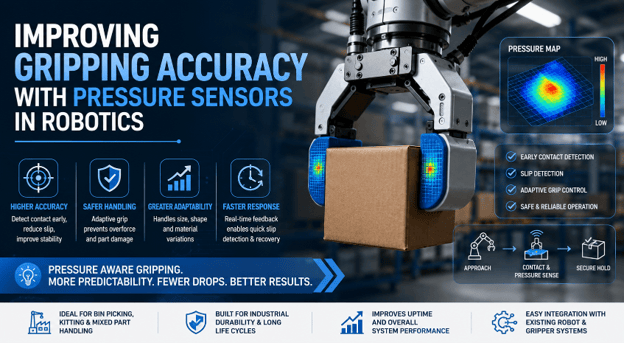
Thanks to this architecture, the UMI gripper can adapt its effort in real time, reducing grasp errors by up to 30% compared to sensor‑free models.
Real‑Time Analysis: Tactile Visualization and Grasp Optimization
The software platform maps pressure data onto instant graphical visualization. Operators can monitor the evolution of applied force at each contact point, quickly spotting critical zones.
This visual feedback enables not only manual adjustment of robot behavior but also training of machine‑learning models for autonomous, optimized grasping. Algorithms learn to predict optimal force distribution based on object shape and material.
Industrial Applications and Future Outlook

- Bin picking in logistics warehouses
- Kitting for medical device production
- Delicate handling of fragile items (glass, electronics)
- Integration into collaborative humanoid systems
Pressure sensors also pave the way for more advanced applications: autonomous mobile robotics capable of manipulating diverse objects without human intervention, and medical assistive robots that can hold instruments with surgical precision.
Conclusion and Call to Action
The integration of pressure sensors into robotic grippers marks a major turning point for industrial robotics. By providing fine sensory perception, they increase reliability, safety, and efficiency of grasping operations.
To stay at the forefront of this technology, invest in advanced tactile solutions like uSkin and train your teams on new control methods. Contact our experts to discover how your company can benefit from this sensor revolution today.


